

Plasma polishing is an advanced surface finishing process that enhances the surface quality, appearance, and performance of metal components. Compared with conventional mechanical polishing methods, plasma polishing delivers a smoother, more uniform surface while minimizing material removal and preserving dimensional accuracy.
This innovative process effectively reduces surface roughness, removes microscopic burrs, and improves corrosion resistance, making it an ideal solution for manufacturers seeking high-quality surface finishes and consistent production results.
Whether you require prototype parts or large-scale production, our plasma polishing service helps achieve outstanding surface quality across a wide range of metal components.
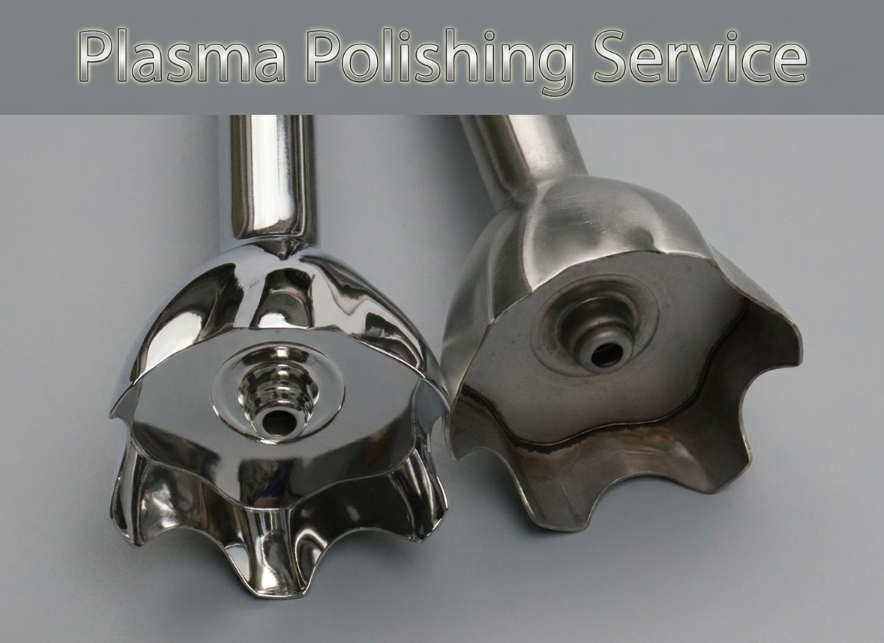
What Is Plasma Polishing?
Plasma polishing is a non-contact electrochemical surface finishing process that removes microscopic surface irregularities through controlled plasma discharge.
Unlike traditional polishing techniques that rely on mechanical abrasion, plasma polishing selectively smooths microscopic peaks on the metal surface without introducing scratches or mechanical stress. The process produces a clean, bright, and uniform finish while maintaining the original geometry of the component.
Because of its excellent precision and consistency, plasma polishing is widely used for components with complex shapes, intricate features, and demanding surface finish requirements.
Benefits of Plasma Polishing
Excellent Surface Finish
Plasma polishing significantly reduces surface roughness (Ra), creating a smooth, uniform surface that enhances both the appearance and functionality of metal parts.
Improved Corrosion Resistance
A smoother surface minimizes microscopic defects where corrosion can begin, helping improve durability and extend component service life.
Effective Burr Removal
Microscopic burrs and sharp edges generated during machining can be removed efficiently without damaging delicate features.
Maintains Dimensional Accuracy
Only a minimal amount of material is removed during the process, allowing tight tolerances and critical dimensions to be maintained.
Ideal for Complex Geometries
Plasma polishing is particularly effective for parts with internal passages, small holes, curved surfaces, and intricate structures that are difficult to polish mechanically.
Consistent and Repeatable Results
The highly controlled process ensures stable surface quality and repeatable finishing across both prototype and production batches.
Materials Suitable for Plasma Polishing
Our plasma polishing service is suitable for a wide range of conductive metals, including:
- ✓ Stainless Steel
- ✓ Titanium
- ✓ Aluminum
- ✓ Copper
- ✓ Brass
- ✓ Nickel Alloys
- ✓ Tool Steel
- ✓ Other Conductive Metal Alloys
Material compatibility may vary depending on alloy composition and surface finish requirements.
Applications
Plasma polishing is widely used for metal components requiring high-quality surface finishing, including:
- • Precision machined parts
- • Industrial equipment components
- • Automotive components
- • Electronic hardware
- • Pumps and valves
- • Fluid handling components
- • Food processing equipment
- • Consumer products
- • Decorative metal components
- • Custom metal parts
Why Choose Plasma Polishing?
Compared with conventional polishing methods, plasma polishing offers several advantages:
These advantages make plasma polishing an excellent choice for manufacturers looking to improve product quality while maintaining manufacturing efficiency.
Our Plasma Polishing Capabilities
We provide professional plasma polishing services tailored to the specific requirements of each project.
Our experienced engineering team evaluates component geometry, material type, surface finish requirements, and production volume to recommend the most suitable finishing solution.
From prototype development to full-scale production, we are committed to delivering reliable quality, consistent performance, competitive lead times, and responsive customer support.
Frequently Asked Questions (FAQ)
What is plasma polishing?
Plasma polishing is an advanced electrochemical surface finishing process that removes microscopic irregularities from conductive metal surfaces using plasma generated in a controlled electrolyte environment. It produces a smooth, clean, and uniform finish while preserving the original dimensions of the component.
What are the advantages of plasma polishing over mechanical polishing?
Unlike mechanical polishing, plasma polishing is a non-contact process. It minimizes the risk of scratches, deformation, and residual mechanical stress while providing a more uniform surface finish. It is also better suited for complex geometries and hard-to-reach areas.
Which materials can be plasma polished?
Plasma polishing is suitable for many conductive metals, including stainless steel, titanium, aluminum, copper, brass, nickel alloys, and certain tool steels. Material suitability depends on the alloy composition and the desired surface finish.
Can plasma polishing remove burrs?
Yes. Plasma polishing effectively removes microscopic burrs and sharp edges left after machining while maintaining the integrity of critical features and dimensions.
Does plasma polishing improve corrosion resistance?
Yes. By reducing surface roughness and eliminating microscopic surface defects, plasma polishing can improve corrosion resistance and help extend the service life of metal components.
Does plasma polishing affect dimensional accuracy?
Material removal during plasma polishing is precisely controlled and typically very small. As a result, the process maintains excellent dimensional accuracy, making it suitable for precision components with tight tolerances.
Is plasma polishing suitable for complex parts?
Yes. Plasma polishing is highly effective for components with intricate geometries, internal channels, curved surfaces, small holes, and other features that are difficult to polish using conventional methods.
Can plasma polishing improve surface appearance?
Yes. Plasma polishing produces a bright, clean, and uniform surface finish that enhances both the functional performance and visual appearance of metal components.
How does plasma polishing compare with electropolishing?
Both processes improve surface finish and corrosion resistance, but they use different operating principles. Plasma polishing generally offers higher material removal efficiency, shorter processing times, and better performance on complex geometries. The most suitable process depends on the material, geometry, and application requirements.
What information is needed for a quotation?
To provide an accurate quotation, we typically require:
- • Part drawings or 3D models
- • Material specification
- • Part dimensions
- • Surface finish requirements
- • Quantity
- • Application or special requirements (if applicable)
Providing complete project information allows us to recommend the most appropriate plasma polishing solution.
Request a Quote
Looking for a reliable plasma polishing service for your metal components?
Whether your project requires improved surface finish, reduced surface roughness, burr removal, enhanced corrosion resistance, or consistent production quality, our experienced team is ready to assist.
Related Articles:
 Best Budget Plasma Cutter – Top 10 Cheap Plasma Cutters Under $500/1000
 Plasma (Ion) Nitriding Process, Temperature, Materials, Uses & Gas Nitriding vs Ion Nitriding
 Guide to CNC Plasma Cutting Machine: How to Use It & Plasma Cutter Gas Selection
 CNC Plasma Cutting Machine vs Laser Cutting Machine: What Are the Differences and Which One to Choose
 Corrosion Testing Methods, Procedure, Standard & Equipment (SST, CCT & More)
 Types of Polishing Process: Advantages, Disadvantages, Uses & Working Principle | CNCLATHING